
Keido API
Your systems, extended.
Your systems, extended.
You already have platforms, portals and pipelines that cannot be replaced. The Keido API puts search, mapping, evaluation and data ingestion inside them, so your teams get Keido’s capability in the tools they already open every morning. It runs within your systems, in your environment.
POST
/search
Hybrid retrieval with citations
POST
/embed
Text to vector, batch or stream
POST
/evaluate
Score against rubrics
POST
/visualise
UMAP projection and clusters
POST
/pipeline
Ingest and update
GET
/governance
Access, observability, audit
Paths are illustrative.
For technical teams
Six endpoints. Every call logged.
Six endpoints. Every call logged.
REST over HTTPS, key and token authentication, deployable in your cloud, hybrid or on-site. Batch and streaming modes where they make sense.
| Endpoint | What it does | Typical use |
|---|---|---|
| Search |
Hybrid semantic and keyword retrieval with context expansion and full citation trails |
A grounded assistant over a research, scientific or government corpus |
| Embedding |
Text to vector, batch or streaming, versioned, compatible with common vector stores |
Feeding your own clustering, classification or ML pipeline |
| Evaluation |
Score outputs against reference answers or custom rubrics: precision, recall, semantic similarity, bias and safety checks |
Gating a model change in CI, or scoring a summariser in production |
| Visualisation |
UMAP 2D and 3D projections with clustering, taxonomy overlays and tenant-aware access |
Embedding a portfolio map in an internal portal or dashboard |
| Data Pipeline |
Ingestion, incremental update, metadata cleaning, versioning and secure transfer with full logging |
Keeping an index current from a records system or data warehouse |
| Governance layer |
Access control, observability and audit across all endpoints, aligned to your framework |
Meeting internal review and external compliance requirements |
A first integration
One Search call, with its citation trail.
One Search call, with its citation trail.
# Request
curl -X POST https://<your-deployment>/search \
  -H "Authorization: Bearer $TOKEN" \
  -d '{
    "query": "coastal erosion monitoring since 2018",
    "top_k": 3,
    "expand_context": true
  }'

# Response (truncated)
{
  "results": [{
    "id": "proj-20814",
    "title": "Remote sensing of shoreline change",
    "score": 0.91,
    "citations": [{
      "source": "grants/2019/GR-4471.pdf",
      "page": 6,
      "passage": "…annual LiDAR surveys across 14 sites…"
    }]
  }],
  "request_id": "req_7f3a…"
}
Deployment options
Three ways to run it.
Three ways to run it.
| Option | Where it runs | Who manages it |
|---|---|---|
| Your cloud |
Your AWS, Azure or GCP account, in region |
Keido deploys, you or Keido operate |
| Hybrid |
Compute in your cloud, sensitive data on-site |
Shared |
| On-site |
Your hardware, air-gapped if required |
You operate, Keido supports |
How the endpoints fit together
Adopt one endpoint, the set, or run agents on top.
Adopt one endpoint, the set, or run agents on top.
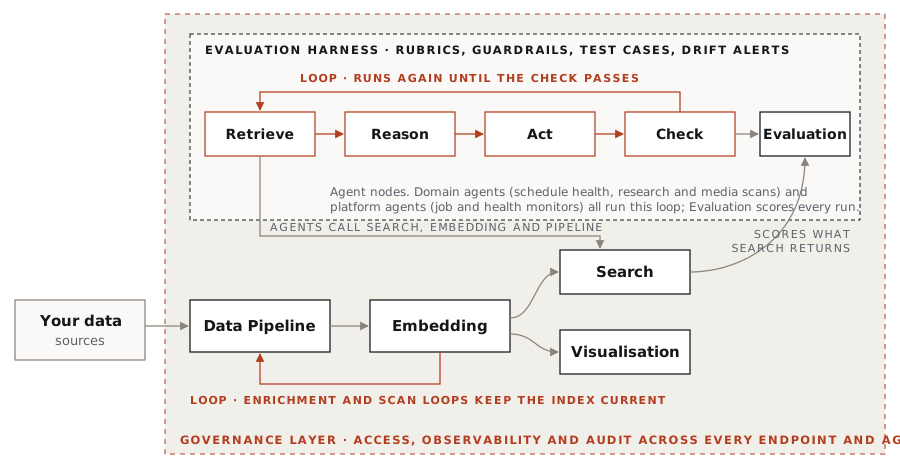
Pipeline feeds Embedding, and Search and Visualisation read from it. Enrichment and scan loops keep the index current.
Agents run a four-step loop, retrieve, reason, act and check, calling Search, Embedding and Pipeline until the check passes. Every run happens inside an evaluation harness, where the Evaluation Engine scores it against your rubrics, guardrails and test cases. Governance wraps all of it, agents included.
Getting access
From call to deployment.
From call to deployment.
- Scoping A 30-minute technical scoping call with your engineering lead
- Sandbox Sandbox credentials against a sample dataset, within a week
- Deployment Into your environment, typically two to four weeks depending on data sources